
 Australia
 Canada
 Cayman Islands
 Dominican Republic
 Hong Kong
 India
India
 Indonesia
 Ireland
 Jamaica
 New Zealand
 Singapore
 Thailand
 United Kingdom
 Vietnam

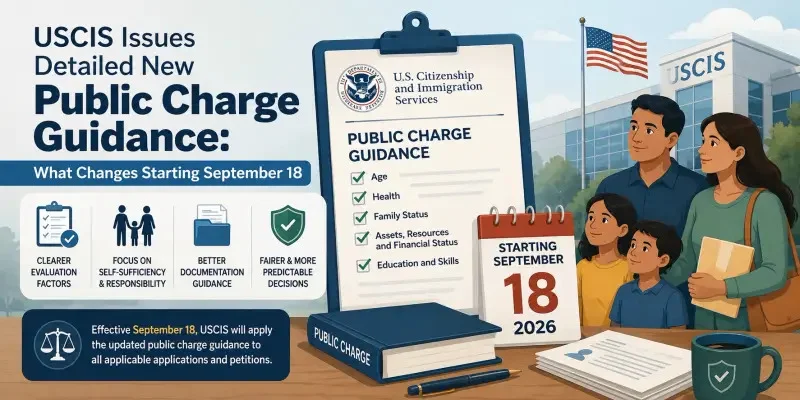
U.S. Citizenship and Immigration Services (USCIS) has issued extensive new policy guidance explaining exactly how the agency will decide whether a green card applicant is likely to become a "public charge". It is one of the most consequential and closely watched inadmissibility grounds in U.S. immigration law. The guidance, released on August 18, 2026, as Policy Alert PA-2026-09 and folded into Volume 8, Part G of the USCIS Policy Manual, implements a Department of Homeland Security final rule that rescinds the Biden-era 2022 public charge regulations. It takes effect September 18, 2026, and will apply to applications to register permanent residence or adjust status (Form I-485) postmarked or electronically submitted on or after that date.
According to USCIS, the updated guidance "aligns with congressional intent that aliens in the United States be self-sufficient and not dependent on taxpayer-funded government benefits." The underlying DHS final rule was announced July 16, 2026, and formally published in the Federal Register four days later, on July 20, 2026.
As always, our EB1A experts have analysed and dissected this update in great detail, as every green card aspirant needs to be aware of the intricacies of the public charge rule and corresponding guidance.
A fourth iteration in under a decadePublic charge inadmissibility, codified at INA 212(a)(4), has been rewritten repeatedly since 2019. The first Trump administration's 2019 Final Rule dramatically broadened what counted against an applicant before it was vacated in litigation in 2022. USCIS then reverted to a narrow standard: the 2022 Final Rule counted only two things against an applicant:
Cash assistance for income maintenance, andLong-term institutionalization at government expense.The new 2026 Final Rule swings the pendulum back toward a broad interpretation, with USCIS stating that the narrower approach "failed to account for all the factors Congress wanted officers to consider when evaluating public charge."
What counts as a public benefit nowThe most important shift now is in what counts as a disqualifying "means-tested public benefit." The means-tested benefits are the ones with eligibility based on income or assets falling below a certain threshold. Under the outgoing 2022 rule, only cash assistance and institutionalization counted. Under the new guidance, any means-tested benefit that is even partly funded by a government agency can now weigh against an applicant. That expanded list now includes:
SNAP food assistance,Government housing benefits,Medicaid, andStudent financial aid for post-secondary education.Earned benefits like Social Security, Medicare, and unemployment insurance remain excluded from this list, since they are not means-tested. Timing would also play an important role in this guideline. Benefits received before September 18, 2026, are judged only under the old and narrower definition. Any benefit received on or after that date would fall under the expanded definition. For instance, someone who enrolled in Medicaid in 2024 is judged under the old rule for that period, but if they continued enrollment past September 18, the new and broader standard would be effective.
The "Totality of the Circumstances" test persistsDespite the substantive overhaul, the core analytical framework of the public charge rule has not changed. USCIS officers must still weigh the "totality of the circumstances". For instance, they will continue considering:
An applicant's age,Health,Family status,Assets and financial resources,Education and skills together, alongside anyAffidavit of Support and history of benefits receiptIn other words, the USCIS will not outright deny a petition based on the candidate's dependence on several programmes. The guidance also preserves several applicant-favorable protections. Primary caregivers for children, or for elderly, or disabled family members continue to receive favorable consideration. Moreover, unpaid caregiving is also explicitly recognized as a legitimate reason for a gap in employment history. Periods of unemployment alone are not, by themselves, treated as evidence of a likely public charge. The same logic also applies to old age and disability: a healthy applicant who is willing and able to work is not likely to be found inadmissible on public charge grounds, even with a relatively low income.
Who the rule applies to and who is exemptThe revised standard applies broadly to:
Applicants for family-based,Employment-based, andDiversity visa lottery green cards, whether adjusting status inside the United States or applying for an immigrant visa abroad,As well as to certain individuals seeking admission on select non-immigrant visas.It also reaches lawful permanent residents who spend more than 180 days abroad and are treated as applicants for admission when they seek to re-enter the country.
Several categories remain outside the rule's reach. Refugees and asylees are exempt, as are green card holders simply renewing their existing status. Moreover, humanitarian categories, including T and U nonimmigrant visa holders and VAWA self-petitioners, are also excluded. This pattern is consistent with statutory carve-outs Congress has long provided for these groups.
The public charge bond optionFor cases that fall short of a clean approval, the guidance details a mechanism largely dormant for years: the public charge bond. If USCIS determines an applicant is inadmissible solely on public charge grounds but is otherwise admissible and eligible, the agency may, in its discretion, invite the applicant (through a Notice of Intent to Deny) to post a bond rather than face outright denial. Applicants cannot submit a bond unless USCIS extends that invitation first; unsolicited bond submissions using Form I-945, Public Charge Bond, will not be accepted. To set the bond amount, officers will weigh how much government assistance the applicant may become eligible for and could potentially receive over the following five years. The guidance also lays out procedures for how bonds may later be breached, maintained, or canceled.
Because the rule turns on filing dates instead of the decision dates, three distinct regimes could now exist side by side. Applications postmarked or filed electronically on or after September 18, 2026, are adjudicated under the new 2026 guidance. Those filed between December 23, 2022, and September 17, 2026, remain governed by the narrower 2022 Final Rule. Anything filed before December 23, 2022, falls under the original 1999 Interim Field Guidance. USCIS has stated plainly that this new guidance "is controlling and supersedes any related prior guidance, including the 1999 Interim Field Guidance."
This transition structure is best illustrated with the following example. For instance, a family member's SNAP enrollment years earlier, could produce different outcomes purely depending on which window an application falls into. Attorneys are advising clients with pending or upcoming filings to review their benefits history now, well ahead of the September 18 cutoff. This is because the postmark or submission date, not the date USCIS ultimately issues a decision, is what determines which standard applies.
If you have any confusion regarding your profile, it is best to verify it with the immigration attorneys. At GCEB1, our eb-1a consultants are staying updated on all the upcoming changes regarding this policy and its relation to a green card profile. For a personalized evaluation of your green card profile, get in touch with GCEB1 today.
Frequently asked questions1. When does the new public charge guidance take effect?September 18, 2026. It applies to Form I-485 applications postmarked or submitted electronically on or after that date, as well as to certain admission requests made on or after that date.
2. What is changing about which benefits count against an applicant?Previously, only cash assistance for income maintenance and long-term institutionalization at government expense counted. Under the new rule, any means-tested public benefit partly funded by government, including SNAP, government housing assistance, Medicaid, and post-secondary student financial aid, can now be considered.
3. Do Social Security, Medicare, or unemployment insurance count against me?No. These are earned benefits, not means-tested benefits, and remain excluded from the public charge analysis under both the old and new guidance.
4. If I received Medicaid before September 18, 2026, will that count under the new, broader rule?No. Benefits received before September 18, 2026, are evaluated only under the narrower definition in effect at the time. The expanded definition applies only to benefits received on or after the effective date.
5. Who is exempt from the public charge ground of inadmissibility?Refugees, asylees, green card holders simply renewing their status, naturalization applicants, T and U nonimmigrant visa holders, and VAWA self-petitioners are all exempt from this ground of inadmissibility.
6. Does receiving unemployment benefits or having a gap in employment hurt my case?Not by itself. Periods of unemployment alone are not treated as evidence of a likely public charge, and unpaid caregiving for children or elderly or disabled family members is explicitly recognized as a legitimate reason for limited employment history.
7. What is a public charge bond, and can I submit one on my own?A public charge bond is an option USCIS may offer, at its discretion, to an applicant who is inadmissible solely on public charge grounds but otherwise eligible. Applicants cannot submit Form I-945 unless USCIS first invites them to do so through a Notice of Intent to Deny; unsolicited bonds are not accepted.
8. Which version of the public charge rule applies to an application I already filed?The version that applies is determined by the date the application was postmarked or electronically submitted; not the date USCIS decides the case. Filings from December 23, 2022, through September 17, 2026, are adjudicated under the 2022 Final Rule; filings before that under the 1999 Interim Field Guidance; and filings from September 18, 2026, onward under the new 2026 guidance.
9. Does age, disability, or currently low income automatically make someone inadmissible?No. A healthy applicant who is willing and able to work is not likely to be found inadmissible on public charge grounds solely due to age, disability, or a currently low income; officers must weigh these factors together with the full totality of the circumstances.
Sources & further readingsU.S. Citizenship and Immigration Services. "USCIS Issues Guidance on Making Public Charge Inadmissibility Determination." U.S. Department of Homeland Security. Accessed August 19, 2026. uscis.gov.U.S. Citizenship and Immigration Services. "Policy Manual Update: Public Charge Ground of Inadmissibility." U.S. Department of Homeland Security. August 18, 2026. uscis.gov.U.S. Department of Homeland Security. "Public Charge Ground of Inadmissibility." Federal Register. July 20, 2026. federalregister.gov.Murthy Law Firm. "NewsFlash! USCIS Issues Sweeping New Public Charge Guidance Effective September 18, 2026." Murthy.com. August 18, 2026. murthy.com.International Legal and Business Services Group. "USCIS Issues New Public Charge Guidance Effective September 18, 2026." Bizlegalservices.com. August 18, 2026. bizlegalservices.com.